
New Haven County Multi-Day Blotter
The county publishes nothing. There is no countywide 72-hour, weekly, or multi-day booking blotter. New Haven County is a map label rather than a jail jurisdiction. Each city keeps its own arrest records. New Haven, Waterbury, and Meriden police departments maintain separate files. CT DOC runs state detention. No shared county window exists. No agency sets a common field list, photo rule, refresh schedule, or archive depth.
A realistic multi-day review blends municipal reports, court updates, and local journalism. Keep them apart. Never stitch them into one fake official roster. New Haven Police points to Police to Citizen. The current public interface and its look-back window go unverified. Meriden's Interactive Reports page is official, but its arrest-history depth is unclear. Waterbury relies on records requests instead of a public blotter.
Read New Haven Arrest Sources
Start with the arresting city and the rough event date. That is the anchor. Working backward from a jail simply guesses at the arrest location. Someone arrested in Meriden may land in a New Haven state facility. Yet the police record stays in Meriden.
- Open the arresting police department’s official reports or records page and look for a dated release, incident reference, or public log.
- Search the Connecticut Judicial Branch for a later criminal case, using the docket and court location to distinguish similar names.
- Review established local news by publication date, noting that an article may appear well after the arrest.
- Ask the municipal records unit for the releasable arrest or booking record when the public page does not reach the needed date.
- For an old item, ask which retention series applies and whether the record was destroyed or transferred.
The 24 Hour Arrests page handles a fresh event and processing lag. This page digs into multi-day searches, editorial reporting, and archives.
New Haven Arrest Log Fields
No official county log exists, so treat these fields as possible identifiers, not guaranteed columns. Their meaning shifts by source. A police report number, court docket, DOC inmate number, and third-party booking ID are not interchangeable.
| Field | How to read it |
|---|---|
| Name | Confirm spelling and identity through the originating agency; similar names can cause false matches. |
| Arrest date and time | Marks the police event and may differ from publication, intake, or court dates. |
| Arresting agency | Identifies the likely custodian of the original report and any booking image. |
| Report or arrest number | Helps retrieve municipal paperwork but is not a DOC or court identifier. |
| Alleged charge | States the initial charge. Confirm amendments and disposition in court. |
| Bond and court | Can change after filing or appearance and never establishes guilt. |
| Photograph | May be agency-contributed or a file image in news. Its presence does not make a story a booking roster. |
A careful log entry keeps the publication date, the charge as reported, the arresting agency, and any court follow-up. Booking photos from police files should never become a gallery.
Meriden Arrest News Patterns
Local news fills in what a booking roster leaves out. The Record-Journal and CT Insider Meriden section is the best of the bunch for Meriden arrests. Reporters there cover selected arrests, warrants, police operations, and court dates. Their stories pull from police releases, social media, warrant papers, and court filings. Some pieces include photos supplied by police. Coverage is editorial, so plenty of arrests never make the paper. A story can also run days or even months after the actual arrest.
Neighboring outlets matter too. The New Haven Register news page tracks New Haven police activity and has written about that city's public arrest-log history. Waterbury items surface through the Republican-American and the CT Insider network. The city itself posts no standalone official blotter online. News explains an event. For the full booking record, go to the arresting agency.
The Meriden news landing page shows headlines around town, not a roster of people arrested. Check the live Record-Journal Meriden source before trusting any current headline.

The section shows editorial coverage at work. Weigh it against police and court records rather than treating it as a full arrest log.
Weekend Arrest Reports and Delays
No official source posts a weekend or holiday upload schedule for New Haven County arrests. Promising a Monday batch or a fixed lag would be fiction. Every step runs on its own clock. Police work, station processing, records review, and court filing all move at different speeds. DOC intake and publication move at different speeds too.
A weekend arrest may first appear in a police release. It may then surface in court. Or it may never reach a public page. News stories can sit until an agency release or court development makes them printable. When dates conflict, log each one. Record the arrest date, the agency release date, the article date, and the court date. That timeline keeps an older story from masquerading as a fresh arrest.
Unofficial Thirty-Day Arrest Index
One unofficial option is the RecentlyBooked New Haven County page, which offers a 30-day view. The site claims refreshes several times daily. It lists name, booking date, booking ID, age, charge, and bond. Those are publisher claims, not a government schedule. The underlying source chain goes unconfirmed. The page itself notes that New Haven County provides no mugshot images.
Treat it as a lead only. It cannot prove current custody, countywide coverage, or a court outcome. Entries may sit stale, incomplete, duplicated, or removed. Any real conclusion needs an official agency or court source.
The screenshot documents the page layout and its stated county context. Open the live unofficial 30-day page to read its current notices and limits.
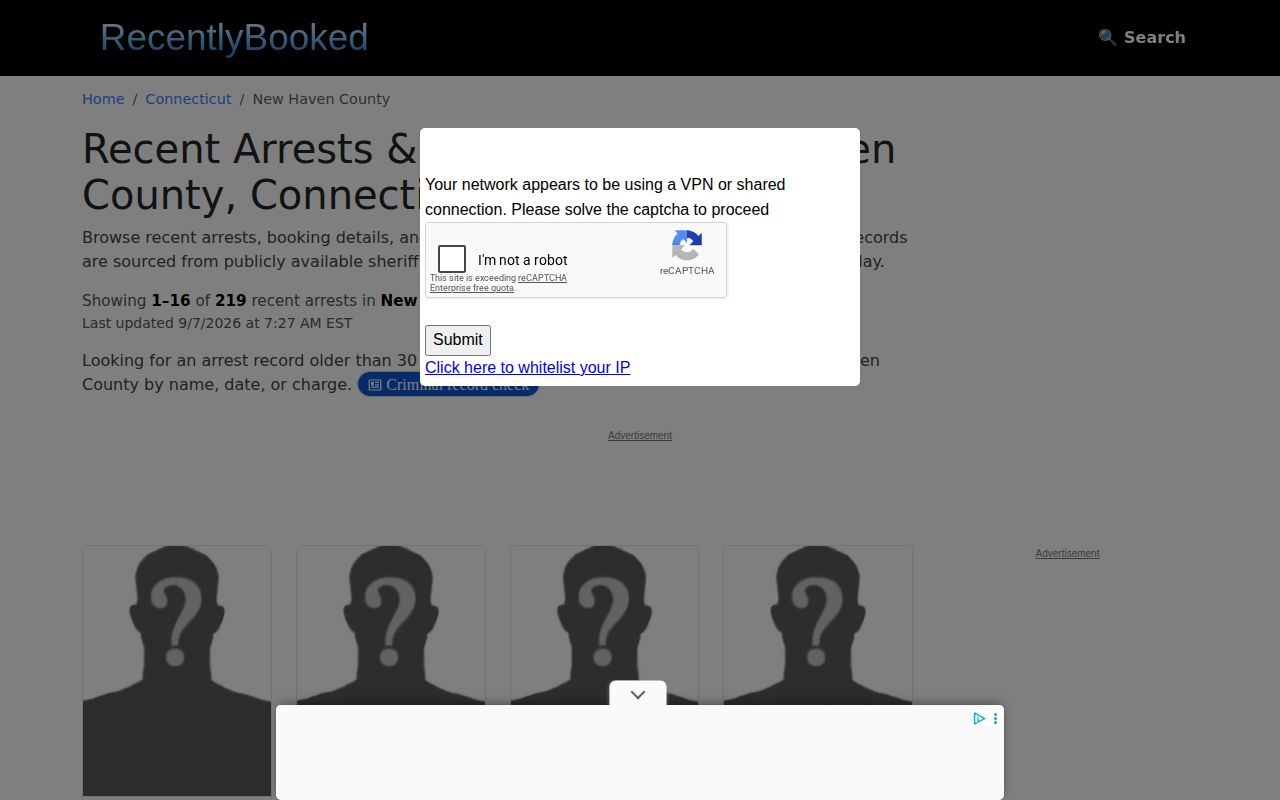
Note: this screenshot documents layout and county context, not an official roster or proof anyone listed remains in custody.
New Haven Arrest Trends Differ
Trend data answers a wider question than a New Haven arrest log. The state's Crime Analysis Unit maintains a repository of crime and arrest figures from participating agencies. New Haven adds its own CompStat reports. Charts can reveal patterns by place and period. Counts also shift as agencies revise their submissions. Never turn a chart into a name list. Read it for changes in reported activity instead. A spike can stem from enforcement focus, reporting habits, data timing, or a genuine shift in incidents, and the numbers cannot pick among those explanations. For any single booking, municipal records and court dockets remain the place to look.
New Haven Arrest Log Archives
Connecticut's Municipal Records Retention Schedule M7 governs municipal public-safety records. It treats every retention period as a floor. Destruction is barred while a FOIA request, lawsuit, or investigation is pending. Authorized destruction runs through Form RC-075. M7 places arrest and booking sheets with case-investigation files. Calls for service, CAD records, blotters, and logs carry a current-year-plus-two-year minimum. That rule is not one blanket term for every booking photo. Cross-series cases take the highest period. Legal limits still apply. For an older arrest record, ask the municipal records unit whether it is in custody, destroyed under an approved schedule, or transferred elsewhere. Transferred files may land with the Connecticut State Archives. An online item's disappearance proves nothing about destruction; court files follow Judicial Branch rules, and news or third-party copies follow their publishers.
Arrest Logs Do Not Convict
A disposition is the court outcome that arrives later. Charges can change, be dismissed, or be nolled. That outcome differs from the initial arrest line.
Keep every source label intact: municipal arrest record, court docket, news story, third-party copy, current DOC custody, or historical archive. Labels matter. Old material is not today's log. The county records hub maps how each channel fits the wider arrest-record lifecycle.